



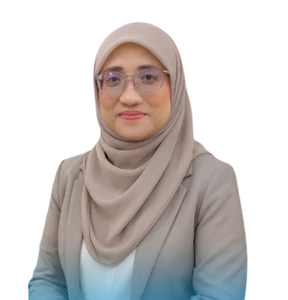
Personal Highlights:
- Director, Department of Rankings, UiTM Global
- Person-in-Charge, Jaringan/Konsortium/Pertubuhan Antarabangsa – Times Higher Education Sustainability Impact Networks (2025–present)
- Doctor of Philosophy (Science) – Universiti Teknologi MARA
- Professional Technologist (Ts.) awarded by the Malaysia Board of Technologist (MBOT)
- Top 28th Researcher in UiTM (2020–2025)
- Main Developer of Massive Open Course Learning (MOOC) – PHY675 Quantum Mechanics
- Resource Person in Quantum Mechanics, Fundamental of Physics and Physics
- Scopus citations: 788; Web of Science citations: 733; Google Scholar citations: 917
- Scopus publications: 84; Web of Science publications: 76; Google Scholar publications: 97
- h-index: 15 (Scopus and WoS); 18 (Google Scholar); Q1/Q2 WoS publications: 57
- 2026 Anugerah Perkhidmatan Cemerlang
- 2025 Anugerah Pengurusan Penarafan Cemerlang, UiTM Global
- Gold Award in INDES 2026
- 2025 Tempat Kedua: Penerbitan Jurnal Q1 Tertinggi 2024, Majlis Sanjung Sarjana UiTM
- 2025 Anugerah Penyelidik Terbaik Fakulti Sains Gunaan
- Gold Award in DASAT 2025
- Gold Award in 2nd SDG Innovation 2025
- PhD and MSc Supervisor
- Research Grants: Principal Investigator: 10 projects, totaling RM515,300.00; Co-Researcher: 26 projects, totaling RM1,797,631.00; Total research projects: 36, totaling RM2,312,931.00
- Consultancy projects include: FESEM-EDX testing for Bupivacaine Hydrochloride Injection BP 0.5% w/v (2024), Pharmaniaga Lifescience Sdn Bhd; FESEM-EDX testing for Esomeprazole 40 mg Powder Solution for Injection (2024), Pharmaniaga Lifescience Sdn Bhd; Research and development of multipurpose foam glass ceramic for industrial application (2023), Keystone Materials; Furniture component specialization course for Forest Research Institute Malaysia (2018)
- Intellectual Property (registered copyrights): Sustainable fluoride-modified bioactive glass from waste materials for dental applications; Synthesis of zinc-doped borate bioactive glass; TeO₂-B₂O₃ mixed glass former for radiation shielding; Mixed alkaline-earth fluoroborate glass for optical properties and radiation shielding
- Chief Editor and Section Editor of two journals
- Speaker and presenter in various conferences
Inspirational Success Story:
Dr.Rosdiyana Hasham@Hisam has developed a distinctive research niche in oxide-based glass materials, with particular interest in understanding the relationship between glass composition, structure and functional properties. Over the years, she has utilised a range of advancedcharacterisation techniques available in Malaysia to investigate oxide glass systems. As her research in glass science progressed, however, the limitations of locally accessible techniques became increasingly apparent, as addressing fundamental questions about glass structure required the ability to probe atomic and intermediate-range capabilities that are not routinely
available through conventional laboratory-based facilities in Malaysia.
To overcome this limitation, Dr. Rosdiyana initiated an international neutron-scattering research project at the ISIS Neutron and Muon Source, United Kingdom, one of the world’s leading centres for neutron-scattering research. The project focuses on the B₂O₃–WO₃ binary glass system and aims to elucidate how tungsten incorporation modifies the borate glass network at the short- and intermediate-range structural levels. In particular, high-resolution neutron scattering will be used to investigate the evolution of trigonal [BO₃] and tetrahedral [BO₄] structural units together with tungsten–oxygen polyhedra, including [WO₄] and [WO₆],
and their contribution to the structural organisation of the glass network.
This research direction builds on Dr. Rosdiyana’s existing research expertise and previous experience in neutron-based investigation of oxide glasses in May 2026, she participated as a co-researcher in an ISIS experiment entitled “Local Environments of Bismuth and Germanium in Binary Bismuth-Germanate Glass.” This direct experience in neutron-based investigation provided a foundation for this subsequent initiative to develop a research direction that employs high-resolution neutron scattering to address structural questions arising from her own research niche.
Significantly, the B₂O₃–WO₃ neutron-scattering project has successfully secured beamtime at the ISIS Neutron and Muon Source, with the experimentscheduled to be conducted in February 2027. This achievement in securing access to an international neutron facility represents an important progression in Dr. Rosdiyana’s scholarly trajectory towards utilising advanced neutron-scattering capabilities. The research also demonstrates Dr. Rosdiyana’s ability to translate a scientific research question into an internationally competitive research proposal and establish collaboration beyond her home institution. The project brings together researchers and postgraduate researchers within a collaborative research framework involving Malaysian institutions, including Universiti Pendidikan Sultan Idris (UPSI), Universiti Sains Malaysia (USM), and Universiti Kebangsaan Malaysia (UKM), together with access to the international neutron research facility at ISIS.
Importantly, the project is also designed to develop research capacity among the next generation of Malaysian researchers. A PhD student who is a member of the research group supported by the project grant will participate in the ISIS experiment alongside Dr. Rosdiyana. Through direct involvement in the experiment, the student will gain exposure to high-resolution neutron scattering, international research-facility operations, data acquisition and advanced structural analysis that are not readily accessible through conventional laboratory facilities. The significance of the initiative therefore extends beyond obtaining beamtime for a single
experiment. It demonstrates a viable pathway for Malaysian oxide-glass researchers to access advanced international research infrastructure, strengthens international research collaboration, and provides postgraduate researchers with direct experience in advanced neutron-based materials characterisation. The atomic- and intermediate-range insights of functional oxide glasses developed from this project may also contribute to the broader development of atomicscale materials research in Malaysia, with potential relevance to the country’s emerging quantum research ecosystem.
For Dr. Rosdiyana, the B₂O₃–WO₃ project marks the transition from applying locally accessible characterisation techniques to leading research that integrates high-resolution neutron scattering for atomic- and intermediate-range structural investigations. By formulating a research question that requires specialised international infrastructure, securing access to ISIS, and involving a PhD researcher in the experimental programme, she is expanding the depth and reach of her oxide-glass research while building specialised capability within the Malaysian research community.
Evidence of Works:
- UiTM Expert Full Profile: https://expert.uitm.edu.my/expert/rosdiyana
- Scopus ID: https://www.scopus.com/authid/detail.uri?authorId=36674865100
Web of Science ID: https://www.webofscience.com/wos/author/record/W-4726-2019
ORCID: https://orcid.org/0000-0002-9183-4988 - https://www.facebook.com/photo/?fbid=1658866646245489&set=pcb.1658866892912131&_rdc=1&_rdr#
- https://www.facebook.com/story.php?story_fbid=1624311383034349&id=100063665078233&mibextid=wwXIfr&rdid=ZzhhAKA0ewlA6sUO
- https://expert.uitm.edu.my/expert/rosdiyana
- https://www.facebook.com/photo.php?fbid=1658866646245489&set=a.461078596024306&type=3&mibextid=wwXIfr&rdid=eKPHNJF6CupHzbjL&share_url=https%3A%2F%2F
- https://www.facebook.com/story.php?story_fbid=1430340642431425&id=100063665078233&mibextid=wwXIfr&rdid=0rGyXY1NhSXw29FN
- https://www.facebook.com/photo.php?fbid=1427555489376607&set=a.461078592690973&type=3&mibextid=wwXIfr&rdid=8lrf8qZMFBqebo6I&share_url=https%3A%2F%2F