



Publication Process
Manuscripts must be submitted exclusively through the journal’s online submission portal (click here). Submissions sent via email will not be considered. Upon submission, a unique Submission ID will be assigned, which must be used in all correspondence.
Authors will receive an acknowledgment of submission within 24 hours. Manuscripts that do not meet the journal’s scope or formatting requirements may be subject to desk rejection.
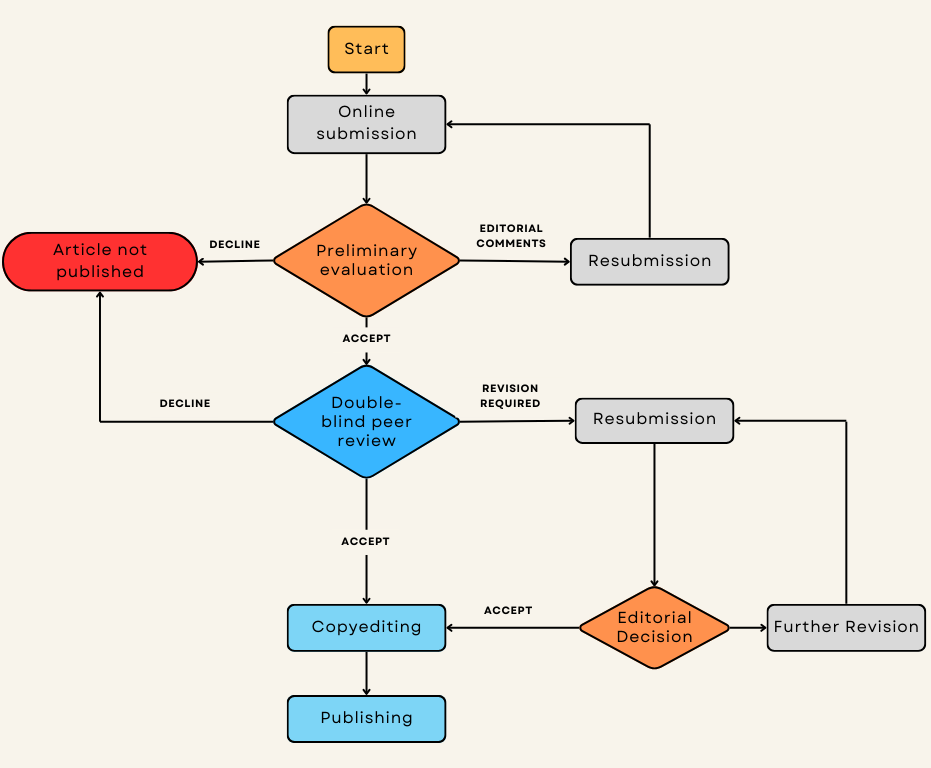
The publication process and timeline is shown below:
|
Process |
Description |
Timeline |
|
Online submission |
The author submits the research article through the online submission portal. | |
|
Preliminary evaluation |
The Editor-in-Chief and/or Associate Editor evaluates the manuscript for its alignment with the journal’s scope, compliance with formatting requirements, and overall readiness for peer review. |
3 - 5 days |
|
Double-blind review |
Upon acceptance by the Editor-in-Chief and/or Associate Editor, the anonymized manuscript is assigned to qualified reviewers based on their expertise and area of specialization. Invited reviewers are given up to one (1) week to accept or decline the review invitation and, upon acceptance, are expected to complete the review within three (3) weeks. |
4 weeks |
|
Revision & Resubmission |
Upon receipt of at least two independent and relevant review reports, the Editor-in-Chief/Managing Editor or any member of the editorial board makes an editorial decision and communicates the reviewers’ comments to the corresponding author via email. The author is required to revise the manuscript in accordance with the reviewers’ and editors’ recommendations. The revised submission must clearly highlight all changes (e.g., using colored text or tracked changes) and include a response-to-reviewers matrix detailing how each comment has been addressed. The revised manuscript must be uploaded through the online submission system under the designated “Revision” file section. |
2 weeks with extension as per author request |
|
Publication acceptance |
The Editor-in-Chief or Managing Editor makes the final decision by assessing the manuscript’s overall quality and readiness for publication. The editor also ensures that all reviewer comments have been adequately addressed and that the manuscript has been properly revised prior to final acceptance. |
1 week |
|
Payment |
Upon acceptance for publication, the author is required to pay the applicable Article Processing Charges (APC) in accordance with the journal’s fee policy. | |
|
Copyediting & Formatting |
The manuscript is forwarded to the copyeditor for final formatting and technical editing. At this stage, the author may be required to address any remaining reviewer comments or complete missing sections, such as declarations and acknowledgments. The copyeditor ensures that the manuscript meets the journal’s formatting standards and is structurally suitable for publication. |
1 week |
|
Article Publication |
The final draft copy of the paper is sent to the author for confirmation. If the author finds necessary corrections, it should be communicated to the editorial assistant through email. The is signed upon confirmation of the final copy of the article. The final proof of the manuscript is sent to the author for review and confirmation. Any necessary corrections must be communicated to the Editorial Assistant via email within the specified timeframe. Upon approval of the final version, the author is required to sign the open access publishing agreement prior to publication. |
The journal aims to complete the process within 60 days, subject to reviewer availability and other factors.
For guidance, download the step-by-step process of article submission and resubmission here.
Publication Schedule
The journal publishes quarterly issues (March, June, September, December). Accepted articles may be released as “online first” prior to issue assignment.
Article Processing Charges (APC)
The journal charges an Article Processing Charge (APC) of USD 50 (PHP 2,300 for authors based in the Philippines). Authors who wish to obtain a printed copy of the journal may do so for an additional USD 50. For international delivery of printed copies, a courier fee of up to USD 20 may be applied. The journal grants 20% reduction in the APC for IIARI recognized fellows.
Manuscript Submission Overview
Checklist Before Submission
Upon submission of the manuscript, the author warrants that:
- The manuscript is an original work and has not been previously published, nor is it under consideration for publication elsewhere.
- All co-authors have been informed of the submission and have agreed to the terms of publication.
- All sources of funding, support, and any potential conflicts of interest have been fully disclosed.
- Permission has been obtained for all copyrighted materials used in the manuscript.
- To the best of the author’s knowledge, all data presented are authentic, accurate, and free from fabrication, falsification, or misrepresentation.
- The manuscript complies with the journal’s prescribed format and includes all required sections, including declarations and acknowledgments.
Article Type
The journal accepts manuscripts within its defined scope and coverage, including original research articles, review articles, and case studies. Submissions must demonstrate strong empirical evidence and make a significant contribution to the field. Manuscripts should be supported by relevant theoretical and/or methodological literature and must be original works that have not been previously published or are under consideration elsewhere. Authors are responsible for obtaining permission for any copyrighted materials used in the manuscript.
The journal publishes manuscripts in English only. Authors are responsible for ensuring that their submissions meet high standards of academic writing, including proper grammar, clarity, and punctuation.
Manuscripts must adhere to principles of respectful and inclusive language. The use of hateful, discriminatory, intimidating, demeaning, or otherwise inappropriate language is strictly prohibited. Authors must avoid any statements that disparage individuals or groups based on gender, race, religion, disability, or other protected characteristics. Discussions should be balanced, objective, and present multiple perspectives where appropriate.
Manuscript Format
The online submission requires only MS Word file. There should be two files uploaded.
| FILE NUMBER | FILE TYPE | DESCRIPTION |
|---|---|---|
| 1 | Anonymous file |
This file is intended for the peer review process. The manuscript must be fully anonymized and must not include the names, affiliations, or any identifying information of the author(s) within the text or file properties. All required declarations must be included in this version of the manuscript. |
| 2 | Title page | This file must contain the title of the article, the names and affiliations of all authors, as well as the abstract and keywords. It should also include all relevant acknowledgment sections and author details, including contact information for the corresponding author. |
The title page must include complete author information, including full names, institutional affiliations, mailing addresses, and email addresses. In the case of multiple authors, the corresponding author must be clearly identified.
The manuscript should include the following components:
- Title – A clear and appropriate title reflecting the content of the article.
- Abstract – A concise summary of the study, with a word count between 150 and 250 words.
- Keywords – A minimum of four (4) and a maximum of six (6) keywords.
Main Body
The main text should include the following sections:
- Introduction
- Literature Review
- Methodology
- Results and Discussion
- Conclusion
- Acknowledgments and Declarations – Including all required statements (e.g., conflict of interest, funding, authorship, etc.)
- References – A minimum of 25 references, with at least 75% published within the last five (5) years
While the journal recommends a standard structure, free-format submissions are acceptable, provided that all required components are included.
The total word count of the manuscript, including references, must be between 6,000 and 8,000 words.
Required Declarations and Acknowledgements:
a. Conflict of Interest and Funding Disclosure. This journal adheres to the Committee on Publication Ethics (COPE) guidelines on conflicts of interest, which may be personal, commercial, political, academic, or financial in nature. Hence, all authors are required to disclose any actual or potential conflicts of interest that could have influenced the results, interpretation, or presentation of their study. These may include, but are not limited to, financial support or compensation (e.g., funding, grants, or commissioned research), political or institutional affiliations, or relationships that could introduce bias, particularly in studies involving the authors’ own institutions or organizations in which they hold leadership or influential positions.
All manuscripts must include a Disclosure Statement. Authors are required to explicitly declare any actual or potential conflicts of interest that may have influenced the research, its interpretation, or presentation.
Examples of disclosure statement:
"Author [Name] declares a financial and business relationship with [Company Name] in the capacity of an employee/consultant, which could be influenced by the findings reported in this study."
"This research was funded by [xxx (name of organization)], with which the author is affiliated."
Example of disclosure statement with no conflict of interest:
"No potential conflict of interest was reported by the authors."
Authors must also disclose all sources of financial support related to the research, including funding, grants, sponsorships, or any form of compensation. The role of the funding source, if any, in the design, data collection, analysis, interpretation, or publication of the study should be clearly stated.
Example of statement with no external funding:
“This work was not supported by any funding.”
Examples of statement with funding:
“This work was funded by [name of organization].”
"This work received no external funding; however, the article processing charge (APC) was covered by [name of paying institution]."
b. Authorship and Contributions Statement. This journal follows the COPE guidance on authorship, which refers to individuals or groups who have made substantial intellectual contributions to the conception, design, execution, or interpretation of the research and the development of the manuscript. The attribution of authorship must reflect a fair balance between intellectual contributions (e.g., study design, analysis, and writing) and other contributions such as data collection or routine tasks. Individuals who do not meet the criteria for authorship should not be listed as authors.
In accordance with the International Committee of Medical Journal Editors (ICMJE) recommendations, all listed authors must meet the following criteria: Substantial contributions to the conception or design of the work; or the acquisition, analysis, or interpretation of data; Drafting the manuscript or revising it critically for important intellectual content; Final approval of the version to be published; and Agreement to be accountable for all aspects of the work, ensuring that questions related to the accuracy or integrity of any part are appropriately investigated and resolved.
For manuscripts with five (5) or more authors, a detailed Author Contributions Statement must be provided, clearly specifying the role of each author. For manuscripts with fewer than five (5) authors, authors may declare equal contribution or specify individual roles; however, the journal strongly encourages transparent reporting of each author’s specific contributions.
Examples of Author Contributions Statement
Equal contributions: “All authors contributed equally to the conception, design, data collection, analysis, and writing of the manuscript. All authors read and approved the final version.”
Detailed contributions: “Author 1 and Author 2 conceptualized and finalized the research framework. Author 3 and Author 4 drafted and revised the manuscript. Author 5 and Author 6 gathered, analyzed, and interpreted the data. All authors contributed to writing the final version of the manuscript.”
Individuals who contributed to the work but do not meet the authorship criteria (e.g., technical support, administrative assistance, or general supervision) must be acknowledged in the Acknowledgments section, with their permission.
c. Responsible Use of Artificial Intelligence (AI). This journal recognizes the responsible and ethical use of Artificial Intelligence (AI) tools as potentially valuable in supporting research and academic writing. However, the use of AI must not compromise the integrity, originality, or credibility of the research. Authors remain fully responsible for the accuracy, validity, and originality of all content submitted.
Authors are required to disclose any use of AI that contributes to the generation of manuscript content. The disclosure must clearly identify the AI tool(s) used and specify the purpose of their use (e.g., summarizing literature, assisting with drafting text, or paraphrasing). The declaration should apply only to AI-generated or AI-assisted content that contributes to the intellectual substance of the manuscript.
The use of AI tools solely for grammar checking, spelling correction, proofreading, or language editing does not require mandatory disclosure. However, authors are encouraged to disclose such use in the interest of transparency.
Example of AI Disclosure Statement
“The authors declare the use of Artificial Intelligence (AI) in the preparation of this manuscript. Specifically, [name of AI tool] was used for [state purpose, e.g., literature search, summarization, or paraphrasing]. The authors take full responsibility for reviewing, verifying, and editing any content generated using AI."
d. Research Ethics. This journal adheres, as appropriate, to the ethical principles outlined in the World Medical Association Declaration of Helsinki (1964) for research involving human participants, including identifiable human material and data; the Code of Federal Regulations (45 CFR 46) on the protection of vulnerable populations; and the Center for Open Science Transparency and Openness Promotion (TOP) Guidelines (2025) to support the transparency and verifiability of empirical research.
Ethics Approval. Authors must provide an Institutional Review Board (IRB) statement indicating the approving institution. For studies derived from theses or dissertations, the approving university ethics committee must be identified. The ethics statement must be included in both the methodology section and as a separate statement before the reference list.
Example:
“This study was conducted in accordance with the ethical guidelines of [institution name] (Approval No. XXX). Ethical clearance was granted by [name of approving body].”
For studies using basic methodologies (e.g., surveys, observations, interviews), a clear statement on informed consent, participant welfare, confidentiality, and data protection is required.
Data and Materials Availability. For studies using basic methodologies, authors must include a data availability and materials statement.
Example:
“The data supporting the findings of this study are available from the corresponding author ([author initials]) upon reasonable request.”
For medical and clinical research, authors must provide a data availability statement indicating deposition in a recognized repository, subject to ethical and legal considerations, and include evidence of ethical approval and trial registration.
Examples:
“The data supporting the findings of this study are openly available in [repository name] at https://doi.org/[DOI], reference number [reference number].”
“The authors confirm that the data supporting the findings of this study are included within the article.”
Informed Consent. In accordance with the Declaration of Helsinki, authors must clearly describe how informed consent was obtained, ensuring that participation was voluntary and that the study’s purpose and procedures were explained prior to data collection.
In addition to the methodology section, studies involving human participants, particularly clinical research and those involving vulnerable groups, must include a consent statement.
Example:
“Informed consent was obtained from all participants [or from parents/guardians, where applicable].”
Participants’ Safety and Welfare. Authors must describe how the study safeguarded participants’ safety and welfare, including adherence to appropriate ethical protocols, particularly when involving vulnerable groups.
Confidentiality and Data Protection. Authors must confirm compliance with applicable data protection laws and regulations and ensure the confidentiality of participants’ information.
Evaluation & Review of Articles
a. Type of Review
The journal employs a double-blind peer review process, in which neither the authors nor the reviewers are aware of each other’s identities. To ensure anonymity, authors are required to submit separate files for the anonymous manuscript and the title page.
b. Review Process
All submitted manuscripts undergo a two-stage evaluation process:
Preliminary Evaluation (Editorial Screening): The Editor-in-Chief and/or Associate Editor assesses the manuscript’s relevance to the journal’s scope, compliance with submission guidelines, and overall readiness for peer review. Manuscripts that do not meet these criteria may be returned to the author or declined without external review.
Peer Review: Manuscripts that pass the initial screening are sent to at least two independent reviewers. Reviewers provide detailed, constructive feedback based on the journal’s evaluation criteria and make recommendations regarding the manuscript’s suitability for publication.
Only reviewers who have accepted the invitation are granted access to the anonymized manuscript. The Editorial Office ensures that reviewers are selected appropriately, with due consideration to expertise and potential conflicts of interest.
The peer review process typically takes one (1) to four (4) weeks, although timelines may vary depending on reviewer availability and other factors beyond the journal’s control. The journal strives to complete the entire review and decision process within sixty (60) days from the date of submission.
c. Review Criteria and Results
Reviewers evaluate submitted manuscripts based on the following criteria: originality, relevance of the research background, adequacy of the literature review, methodological rigor, clarity and validity of results and discussion, strength of conclusions, and overall quality of presentation. While reviewers are provided with guiding questions, they retain the flexibility to exercise independent academic judgment in assessing the manuscript.
Based on the reviewers’ evaluations, the editorial decision may fall under one of the following categories: accept submission, revision required, resubmit for review, submit elsewhere, or decline submission. The final decision is made by the Editor-in-Chief or Managing Editor after considering at least two independent peer review reports. The decision is formally communicated to the corresponding author through the journal’s official communication channels.
Accept Submission. The manuscript is accepted for publication and proceeds to the copyediting stage. The author is required to pay the Article Processing Charges (APC) and sign the open access agreement form.
Revision Required. The manuscript requires minor or major revisions. It is returned to the author with reviewers’ and editors’ comments for improvement. Authors are normally given two (2) weeks to submit the revised manuscript. Requests for extension may be considered if justified. During submission of the revised files, the author must upload three documents through the online submission portal: 1) anonymous manuscript; 2) title page and 3) matrix of action taken form. The revised manuscript will be evaluated by the Editor-in-Chief or a designated member of the Editorial Board, and may undergo further rounds of revision if necessary. Upon final acceptance, the author is required to pay the APC prior to publication and sign the open access publishing agreement.
Resubmit for Review. The manuscript requires substantial revisions and must undergo a new round of peer review. Reviewers’ comments are provided to guide the author in revising the manuscript. Authors are given sufficient time to address the required changes and may request an extension if necessary. The revised submission will be treated as a new review cycle.
Submit Elsewhere. The manuscript is not suitable for publication in the journal’s scope or standards. Authors are encouraged to consider submission to a more appropriate journal.
Decline Submission. The manuscript is rejected due to significant concerns regarding quality, originality, methodology, or ethical compliance. The submission will not be reconsidered for publication in the journal.
Guidelines for Reviewers
Selection of Reviewers
Recruitment of Reviewers
The journal recruits experts in the field to assist the editor in the evaluation and acceptance of papers. Reviewers are selected based on their qualifications and specialization. All reviewers must register through the OJS/PKP submission portal. Upon registration, interested reviewers may indicate their willingness to receive review assignments by selecting "Yes, I would like to be contacted with requests to review submissions to this journal." All recognized reviewers receive a certificate of recognition, in accordance with journal policies and ethical standards.
Selection of Reviewers for an Article
All editorial board members and reviewers must sign up through the online submission portal. This facilitates the submission, review, and acceptance of all papers. External reviewers are considered for each manuscript based on their expertise and relevance to the subject matter. The editor or designated editorial staff is responsible for selecting reviewers to ensure an appropriate, unbiased, and qualified peer review process. Reviewers are not selected randomly but are assigned based on their specialization, research interests, and the absence of conflicts of interest.
Acceptance of the Review
Selected reviewers may either accept or decline an invitation to review. Reviewers are given a maximum of one week to accept the review task, and the review itself is expected to be completed within a period of three weeks. If a reviewer is not confident in undertaking the review, they should decline the invitation promptly rather than ignore it, and are expected to inform the editorial office accordingly.
Review Process
All submitted manuscripts undergo a two-stage evaluation process:
Preliminary Evaluation (Editorial Screening): The Editor-in-Chief and/or Associate Editor assesses the manuscript’s relevance to the journal’s scope, compliance with submission guidelines, and overall readiness for peer review. Manuscripts that do not meet these criteria may be returned to the author or declined without external review.
Peer Review: Manuscripts that pass the initial screening are sent to at least two independent reviewers. Reviewers provide detailed, constructive feedback based on the journal’s evaluation criteria and make recommendations regarding the manuscript’s suitability for publication.
Only reviewers who have accepted the invitation are granted access to the anonymized manuscript. The Editorial Office ensures that reviewers are selected appropriately, with due consideration to expertise and potential conflicts of interest.
The peer review process typically takes one (1) to four (4) weeks, although timelines may vary depending on reviewer availability and other factors beyond the journal’s control. The journal strives to complete the entire review and decision process within sixty (60) days from the date of submission.
The journal uses the OJS-PKP platform and workflow for the submission and review of articles. For guidance and assistance in using the portal, you may download the workflow guidelines here.
Editorial Code of Conduct
Editorial Independence. The Editorial Board has full authority over the acceptance or rejection of manuscripts without interference from the publisher and/or external bodies. All editorial decisions must be made impartially, based solely on the scholarly merit, originality, and relevance of the submission, and in accordance with the journal’s publication standards and ethical guidelines.
Members of the Editorial Board may submit manuscripts to the journal; however, to avoid potential conflicts of interest, such submissions must be limited to one (1) research article per year. All submissions from Editorial Board members must be treated as regular manuscripts and undergo the standard peer review and editorial process, without any preferential treatment.
Conflict of Interest. Reviewers must disclose any actual or potential conflicts of interest related to a manuscript under review. In accordance with the COPE guidelines, conflicts of interest may arise from personal, financial, intellectual, professional, political, or religious relationships or considerations that could influence, or be perceived to influence, the reviewer’s judgment.
Reviewers are required to declare such conflicts through the OJS/PKP submission system by selecting the option, “I may have competing interests,” and providing relevant details where applicable. If a significant conflict exists, reviewers should decline the review assignment.
Ethical Use of Artificial Intelligence (AI) in Review Process. This journal recognizes the potential role of Artificial Intelligence (AI) tools in supporting the peer review process. However, their use must be responsible, limited, and must not compromise the confidentiality, integrity, or independence of the review.
Reviewers are expected to exercise independent scholarly judgment in evaluating manuscripts. AI tools may be used only for limited and general assistance (e.g., improving clarity of language in the review report), and must not replace the reviewer’s critical assessment.
To protect confidentiality and intellectual property, reviewers must not upload, share, or input any part of the manuscript, including text, data, figures, or supplementary materials, into any AI tool or external platform. This restriction applies to both public and private AI systems.
Reviewers must not use AI to generate substantive content of the review report, including evaluations, interpretations, or recommendations. The review must reflect the reviewer’s own expertise and original assessment.
The use of AI tools solely for grammar checking, proofreading, or language editing of the review report is permitted. Reviewers remain fully responsible for the content, accuracy, and integrity of their review.
Confidentiality. Reviewers and editors must treat all submitted manuscripts with strict confidentiality. They must not disclose, discuss, or share any information about the manuscript or its review with others, except as authorized by the journal. This obligation applies both during and after the peer review process. Reviewers must not use any part of the manuscript, including data or ideas, for personal advantage or the advantage of others.
Reviewers may share or upload certificates of recognition or merit related to their review activity on professional platforms or social media, provided that no confidential information about the manuscript, authors, or review process is disclosed.
Timeliness. Reviewers and editors are expected to respond promptly to review invitations and to complete their evaluations within the agreed timeframe. If a reviewer is unable to complete the review on time, they should promptly inform the editor. All participants in the editorial process must act efficiently and responsibly to ensure the timely handling of manuscripts.
Review Results
Reviewers evaluate submitted manuscripts based on the following criteria: originality, relevance of the research background, adequacy of the literature review, methodological rigor, clarity and validity of the results and discussion, strength of the conclusions, and overall quality of presentation. While reviewers are provided with guiding questions, they retain the flexibility to exercise independent academic judgment in assessing the manuscript.
Based on the reviewers’ evaluations, the editorial decision may fall under one of the following categories: accept submission, revision required, resubmit for review, submit elsewhere, or decline submission.
Accept Submission. The manuscript is accepted in its current form, indicating that it satisfies all the necessary criteria for publication in the journal.
Revision Required. The manuscript requires minor or major revisions. It demonstrates potential for publication; however, certain parts of the paper require modification or clarification.
Resubmit for Review. The manuscript requires substantial revisions and must undergo a new round of peer review. While the paper shows potential for publication, significant changes are needed that may affect the content and structure of the manuscript.
Submit Elsewhere. The manuscript is not suitable for publication within the journal’s scope or does not meet its standards. Authors are advised to consider submission to a more appropriate journal.
Decline Submission. The manuscript is rejected due to significant concerns related to quality, originality, methodological rigor, or ethical compliance.
Benefits of Becoming a Reviewer
Editorial board members and reviewers serve on a voluntary basis; therefore, no monetary compensation is provided for their services. However, the journal offers non-financial and limited financial incentives, including the following:
- Free Publication. Editorial board members and reviewers are granted one free publication in any journal after completing five (5) quality reviews.
- Certificate. All recognized editorial board members and reviewers receive a certificate of recognition.
- Outstanding Reviewer of the Year. All reviewers are eligible for the annual Outstanding Reviewer of the Year award. Details of the award are available here.
Business Model
Our Business Model
IIARI publishes open-access articles supported by Article Processing Charges (APCs), organizes conferences and events with registration fees, and provides printed copies of journals through a Print-on-Demand scheme. Depending on the type of publication, the institute charges a specific fee, which includes peer review, language editing, layout, and copyediting services. As a non-stock, non-profit organization, the institute sustains its operations, activities, international events, and competitions through the fees collected from its clients.
Publishing Revenues
The institute’s primary sources of revenue include:
Article Processing Charges (APCs). A specified fee is charged for the publication of articles in the journal. Open-access articles are assigned DOIs and are made readily available online in PDF format. The journal is indexed in DOAJ, among other platforms. Full journal issues are also made available through Google Books.
Conference and Event Registration Fees. Fees are collected from participants of conferences, seminars, and other academic events organized by the institute.
Institutional and Individual Membership Fees. The institute collects membership fees from institutions and individuals, which support its academic and research initiatives.
Sale of Printed Journals. Printed copies of journals are offered for sale through a Print-on-Demand scheme.
Post-publication Guidelines
Issuance of certificate of publication
Published authors receive a Certificate of Publication. Corresponding authors are issued an e-Certificate of Publication by the editorial assistant once the paper is published online, subject to the completion of the open access agreement form. All communications and the release of e-certificates are conducted through the corresponding author’s email address.
Appeal, complaints & corrections
The journal systematically addresses issues related to author appeals, complaints, and post-publication corrections. All appeals, complaints, and correction requests related to publication must be submitted via email to the the editor-in-chief or managing editor. Ethical complaints involving any editorial staff must be directed to the publisher through the president (president@iiari.org).
Review Results, Comments, and Suggestions (Appeals Process)
Authors whose manuscripts have been rejected have the right to appeal the editorial decision. The journal ensures that the reasons for rejection, including suggested improvements, are communicated to the author. Authors may seek further clarification by submitting an appeal via email to the editor-in-chief or managing editor, clearly explaining the grounds for reconsideration.
An ad hoc committee composed of three members of the editorial board shall be formed to evaluate the merits of the appeal. The committee’s decision shall be final and will be communicated to the author.
Corrections and Retractions
The journal ensures that authors receive manuscript proofs for confirmation, verification, and approval prior to publication. Any corrections before publication must be communicated via email to the copyeditor.
If errors are identified after publication, authors must report them via email to the editorial assistant, journal manager, or editor-in-chief. Minor errors, including typographical or grammatical issues, may be corrected through in-line corrections or the publication of an erratum.
Serious concerns, such as plagiarism, misrepresentation, falsification of data, or other forms of academic misconduct, may result in the retraction of the article, in accordance with established ethical guidelines.
Retraction cases are handled systematically by the Editor-in-Chief, Managing Editor, or Editorial Office. Authors are given sufficient time to respond to the concerns and to provide necessary corrections. Where appropriate, substantial corrections may be published as an erratum. If the author fails to address the concerns adequately, the article may be retracted. All decisions are communicated to the author via email.
Editorial Concerns
The journal upholds the highest standards of publication ethics in all editorial processes. If an author observes inappropriate or unethical behavior by any member of the editorial team, the complaint must be reported via email to the publisher through the president.
Such misconduct includes, but is not limited to: soliciting bribes in exchange for acceptance of a manuscript; discrimination, harassment, intimidation, or demeaning conduct; and offensive verbal or written statements related to gender, race, religion, or disability.